
Madison Work Camp Release Paths
Madison Work Camp belongs to the state-prison system. FDC’s current institution page identifies it as a Madison Correctional Institution satellite. An offender can move from the camp back to the main institution, to another FDC unit, or out of prison under a lawful release. The first two events change location but do not end custody.
A community release may occur at sentence expiration or through an authorized release mechanism. State supervision can follow. The person may then appear in both a historical inmate record and a supervised-population record. Use the exact FDC status instead of assuming every post-prison case is parole. Conditional release and probation have different legal sources and must keep their own labels.
Nothing in the Madison County Jail portal certifies this movement. SmartWEB is a Sheriff system for county bookings. It does not cover Madison Work Camp assignments, FDC transfers, or state discharges.
Confirm a Work Camp Release
The FDC inmate search is the starting point. Search by DC number when possible. That identifier is six characters and is either all numbers or one letter followed by five numbers. A name search uses prefixes and can return several similar people, so always open the detail and compare more than the list row.
- Enter the DC number, or search by name with aliases when needed.
- Open the offender detail and verify identity, offenses, sentence data, status, and institution history.
- Read any tentative or actual release field by its displayed label. Do not turn a projection into a completed event.
- Use the dedicated FDC release search to check a scheduled or past release.
- Use the supervised-population search to see whether state control continues in the community.
- Contact Central Records when a recent camp movement, location, or date conflicts with the public record.
The Madison County custody-system overview explains why county and state results cannot be swapped. A transfer warning belongs beside every camp lookup.
Madison Work Camp Records Route
The reviewed official source does not provide a separate, verified Madison Work Camp address or telephone block. Do not copy an old directory entry or treat Madison CI’s address as the camp’s address. Route current operational questions through Madison Correctional Institution or FDC, and ask staff to confirm whether the satellite is separately operating before directing mail or a visit.
A formal release or discharge record should go to FDC Public Records. Include the person’s full name and DC number. Ask for the release date and type, institution or unit of release, any transfer history needed to understand the departure, and any supervision that followed. FDC Central Records handles offender-search accuracy questions at (850) 488-9859. Madison CI’s main line is (850) 973-5300 for operational routing, not proof of discharge.
These are parent-agency routes, not published contact details for the camp. The distinction avoids giving a false impression that the camp has a verified public desk, mailing address, or direct telephone. A request can also ask FDC to state the unit’s current official contact if that fact is needed.
Madison Work Camp Custody
The work camp is identified as an FDC satellite of an adult male institution. That relationship controls the search method. A satellite assignment is part of a state-prison term, not a new Madison County Jail booking. The state offender detail may show the location or a later transfer, while Central Records can reconcile movements that the public screen does not fully explain.
No separate camp capacity was verified. The capacity figure of 1,054 on FDC’s page applies to the listed institution and should not be recast as a work-camp number. Visitation hours and the main institution’s street address also should not be copied into a camp contact card without an official source that assigns them to the satellite.
The records boundary matters after release too. A Madison County court case might explain a sentence, but FDC documents the state custody episode. The Sheriff’s historical release search can answer a prior county-jail booking. It cannot show whether an offender later left the work camp, transferred within FDC, or entered state supervision.
Is Madison Work Camp Open?
The current FDC page for Madison CI lists Madison Work Camp as a satellite. A 2021 PREA audit reported that the camp was closed at the time of that audit. The sources speak from different dates, so the conflict is temporal. The older statement is not enough to declare permanent closure, and the newer satellite line does not by itself verify separate present-day operations.
Describe the unit as a currently listed satellite whose separate operation and contact must be confirmed. That phrasing preserves both official facts. It also avoids a common records error: a person assigned to a satellite in an older FDC entry may later appear at the main institution or elsewhere without ever leaving state custody.
Call Madison CI or FDC before relying on the camp name for mail, visitation, or direct contact. For release verification, no special camp database is needed. The FDC offender detail and public-record route continue to control regardless of which part of the institution handled the assignment.
Note: Current listing status does not establish a separate camp phone, street address, or public service counter.
Work Camp FDC Search Fields
The Corrections Offender Network uses distinct searches for current inmates, releases, and supervised people. The public inmate form accepts last name, first name, and DC number. It can include aliases, suppress list-page photos, or limit results to records with photos. The detail is more useful than the result row because it holds the broader identity, offense, sentence, location, and date context.
| Record | Question answered | What it cannot prove alone |
|---|---|---|
| Inmate detail | Is the person in FDC and what location/status is shown? | That a projected release has occurred |
| Release search | Is a release scheduled or historically recorded? | That all supervision has ended |
| Supervised population | Does FDC supervision follow prison? | The exact gate or physical departure time |
| Public-record response | What formal movement and release fields does FDC hold? | Facts outside the responsive state record |
FDC states that current inmate data are fully refreshed weekly, while release dates and location changes update nightly. The release search updates nightly. Supervision data are refreshed weekly, with termination dates and location changes updated nightly. A recent event can still require direct confirmation because FDC warns that information changes quickly.
The FDC search screen shows the fields and scope warning used for a Madison Work Camp lookup.
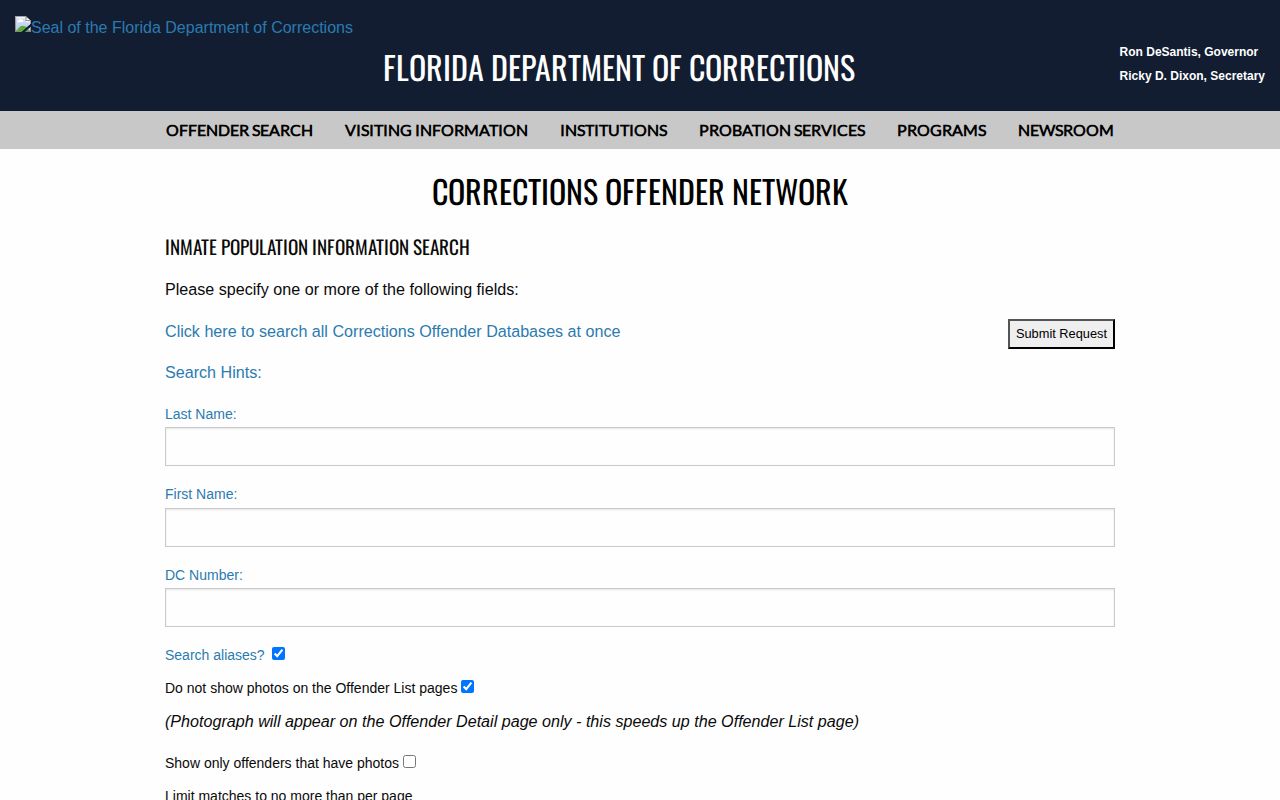
The state form also explains why a county-only jail or probation record may be absent: FDC covers people sentenced to state prison or state supervision.
Work Camp Release Date Meaning
A tentative release date is not a guarantee. Under Florida section 944.275, it is FDC’s projected date after the agency applies the sentence, lawful credit, and gain-time rules. Granted or restored gain-time can move it earlier. Forfeiture, a new sentence, escape or parole-violation time, and corrected computation can move the framework later.
For covered post-October 1, 1995 offenses, gain-time generally cannot produce release until at least 85 percent of the imposed sentence has been served, counting court-awarded credit for time physically confined. The rule does not promise release at that point. Mandatory terms, offense exclusions, disciplinary forfeiture, and sentence structure can result in more time.
Once a completed release appears, check the status and the supervision database. A person may be out of prison but still subject to FDC supervision. Conversely, a new location within FDC is evidence of transfer rather than release. The exact labels on the offender detail are more reliable than a date copied without context.
- Satellite
- A unit tied to a main FDC institution for administrative and custody purposes.
- Transfer
- Movement within or between custody systems without community release.
- Tentative release date
- The state’s current projected date, subject to lawful recalculation.
- Supervision
- State control in the community under the category shown in the FDC record.
Formal Work Camp Release Record
A focused FDC request should identify one person and one custody period. Use the DC number, approximate dates, and the work-camp or Madison CI reference shown in the public record. Ask for the movement history needed to distinguish reassignment from release, the actual release date and type if completed, the institution of release, and any state supervision that followed.
Do not ask the Sheriff to interpret an FDC record. Do not infer camp operation from a stale third-party listing. FDC can confirm the current satellite relationship and the state custody event. When a court order is needed to explain the legal basis, obtain that order from the proper Clerk, then pair it with the FDC record rather than replacing one with the other.
Note: The absence of a separate camp contact block is a routing limit, not proof that no responsive FDC records exist.