
Madison Projected Versus Actual Release
A projected date estimates when custody may end under the facts then in the record. Florida law uses the more exact term tentative release date for the date on which gain-time is projected to release an FDC prisoner. An actual release date records an event that has already occurred. A maximum sentence expiration date is another field: it begins with the term imposed and is reduced by lawful credit, but it is not interchangeable with the tentative date.
Pretrial custody works differently. A person awaiting trial in Madison County Jail generally has no sentence-completion date because release may turn on bond, a court order, dismissal, a plea, or another legal event. Bond release occurs when the court's terms and jail processing are satisfied. A transfer to Madison Correctional Institution or another custodian ends the local jail episode but is not release to the community.
| Record term | Meaning |
|---|---|
| Tentative release date | FDC's projected date after the lawful gain-time calculation |
| Maximum sentence expiration | The sentence endpoint after lawful credit, subject to the governing sentence structure |
| Actual release date | A historical date showing that a release event was processed |
| County jail release time | The Sheriff record of when a local booking episode ended |
Find Madison Projected Release Dates
The first question is whether the person is in Madison County Jail or the FDC system. SmartWEB covers the county booking episode. The FDC Corrections Offender Network covers state prisoners and state supervision. Its scope expressly excludes county-jail-only sentences and county probation, so a failed FDC search can be expected in a purely local case.
- Identify the custodian. Check Madison SmartWEB for county custody and FDC for a state-prison sentence.
- For FDC, search by DC number when known. Otherwise use a name and compare aliases, descriptors, photograph, offenses, and sentence data.
- Open the detailed record. Copy the exact field label, value, and available update context.
- Run the dedicated FDC release search to compare scheduled or historical release information.
- For a Madison County Jail sentence, inspect the judgment, jail credit, and court docket. Ask the jail or Clerk to explain the source record.
- For a near-term event or a conflict, contact FDC Central Records, the jail, or the sentencing court as appropriate.
The Madison County release lookup provides the wider path for confirming whether a person was released, transferred, or remains in another system. Date calculations should never be separated from that status check.
The FDC inmate search shows the public identity fields and the warning about fast-changing location, status, and release data.
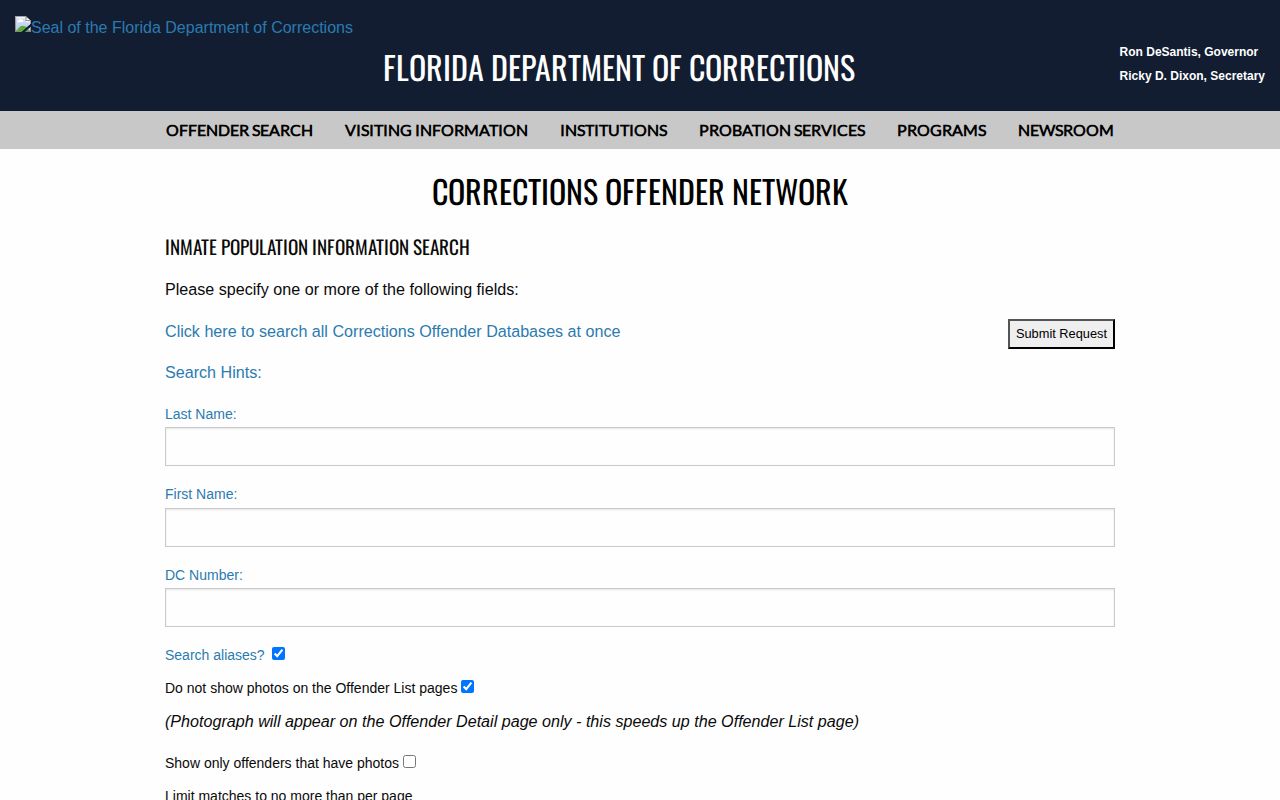
The detail record, not the list row alone, is the proper place to compare the date with the sentence and identity.
Note: FDC date updates cannot be assigned to Madison SmartWEB, whose public refresh schedule is not published.
Madison FDC Release Search Choices
FDC publishes several databases for different stages. The current inmate-population search is completely refreshed weekly, with release dates and location changes updated nightly. The dedicated Inmate Release Information Search contains people already released or scheduled for release and updates nightly. The supervised-population database receives a weekly full refresh, with termination dates and location changes updated nightly.
Use more than one view when the person is near release. An inmate detail may show the projected date. The release search may show a scheduled or completed event. After release, the supervised search may show that the person left prison but remains under FDC authority. A supervised status is not the same as a full sentence discharge.
FDC's public OBIS material says its released-inmate root data cover people released since October 1, 1997 and connect to aliases, offenses, detainers, and incarceration history. That boundary describes the state data set. It is not a Madison County Jail retention rule, and it does not prove that an older government record was destroyed. When the interactive search does not resolve an older state-prison date, make a focused FDC records request with the DC number. For an old county episode, ask the Sheriff or Clerk instead.
The Corrections Offender Network menu displays the distinct population, release, supervision, absconder, and escape databases.
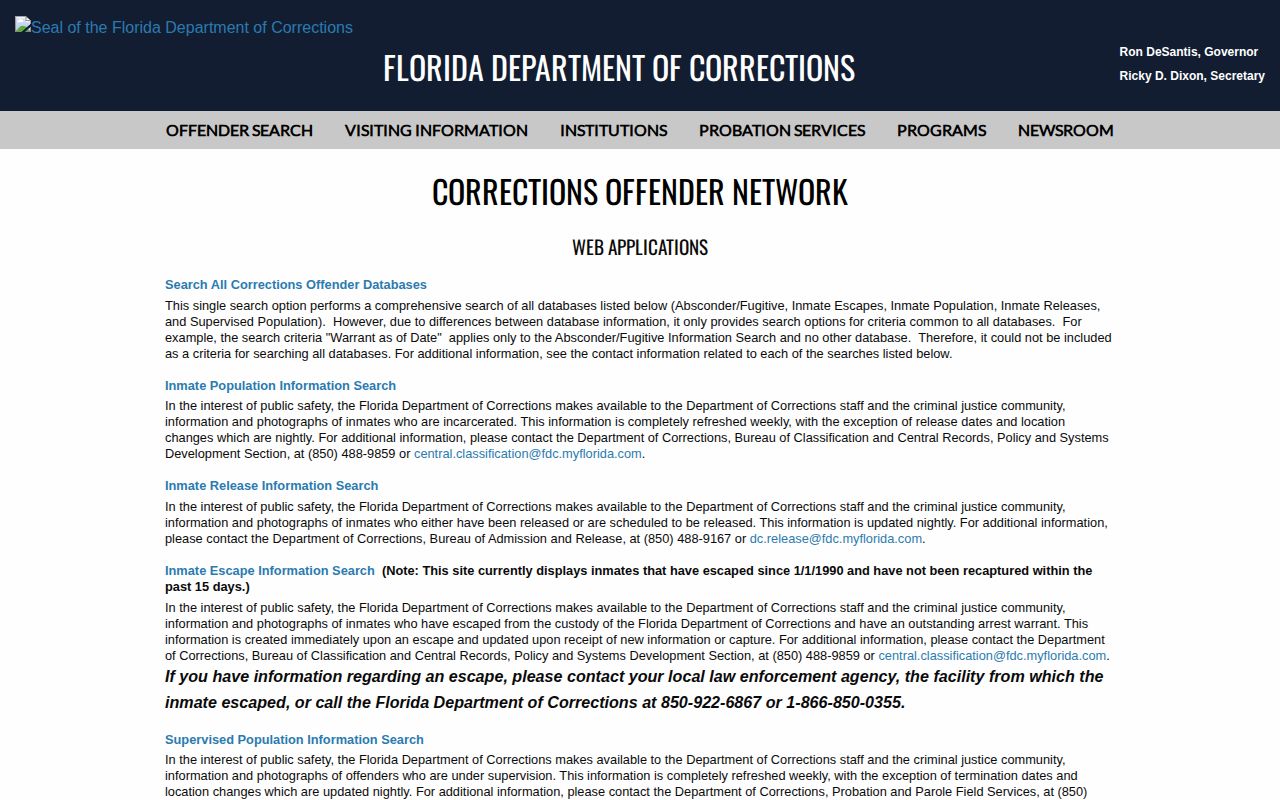
Choosing the database that matches the legal stage prevents a current-custody result from being treated as proof of release.
Florida Gain-Time for Madison Releases
Florida Statutes section 944.275 controls the core FDC gain-time terms. Subsection (2) requires FDC to establish the maximum sentence expiration date for a term-of-years sentence and subtract lawful credit, including court-awarded jail credit. Subsection (3) defines the tentative release date as the date projected for release through gain-time.
For offenses committed on or after October 1, 1995, FDC may grant up to ten days per month of incentive gain-time for qualifying conduct or participation. The rate and eligibility law in effect on the offense date matter. Certain offense categories are excluded, and mandatory minimum or other sentence rules may require more time. The statute should be read for the controlling date and sentence rather than reduced to one universal credit.
The often-cited 85 percent rule appears in section 944.275(4)(f). For a prisoner subject to that provision, FDC cannot award gain-time that would produce release before at least 85 percent of the imposed sentence has been served. Court credit for time physically incarcerated counts toward the minimum. This is a floor, not a promised release point. A person can serve more because of an ineligible offense, mandatory minimum, disciplinary loss, sentence structure, or lack of awarded gain-time.
- Gain-time
- A lawful FDC sentence credit that can affect the tentative release date.
- Jail credit
- Credit awarded for qualifying time already spent physically confined.
- Mandatory minimum
- A sentence rule requiring at least a stated period despite other credit rules.
- Concurrent sentences
- Terms served at the same time, subject to the actual judgment.
- Consecutive sentences
- Terms served one after another, which changes the combined calculation.
Madison Release Calculation Limits
Florida's tentative release date can move earlier when qualifying gain-time is granted or restored. It can move later when gain-time is forfeited. New sentences during the commitment can require FDC to recompute the date. Escape time, parole-violation time, corrected jail credit, mandatory minimums, and later court documents can also alter the framework.
Do not calculate a release date by multiplying the sentence by 0.85. That shortcut ignores concurrent or consecutive terms, offense-date-specific gain-time rules, excluded offenses, sentence enhancements, disciplinary forfeiture, restored credit, and court corrections. The public FDC date is the useful current estimate. Central Records and the sentencing court are the reconciliation sources when the math appears inconsistent.
| Factor | Possible effect | Where to verify |
|---|---|---|
| Granted or restored gain-time | Can move a tentative date earlier | FDC detail and Central Records |
| Gain-time forfeiture | Can move the date later | FDC record |
| Corrected jail credit | Can change the sentence computation | Sentencing order and FDC |
| New sentence | May require recomputation | Court docket and FDC |
| Detainer or hold | May prevent community release or cause transfer | Holding and receiving agencies |
| Parole or conditional action | May change the release or supervision path in eligible cases | FCOR order and FDC |
A detainer deserves special care. It is a request or hold from another authority. The prison or jail episode can close while the person moves into the other agency's custody. That event is not a return to the community, even if one database later labels the first episode released.
Note: Record the date label and update context together, since the same number can mean different things in different systems.
Madison County Jail Date Rules
The state 85 percent and FDC gain-time calculation does not automatically govern a Madison County Jail term. Local release depends on the judgment, lawful jail credit, applicable county authority or policy, court orders, and any holds. The reviewed Sheriff material publishes no Madison jail good-time formula and no weekend or holiday early-release rule. A reader should not transfer the FDC math to a county sentence.
For a sentenced jail inmate, obtain the judgment and sentence from the Madison Clerk, confirm awarded custody credit, and ask the jail how the order is being applied. For a pretrial detainee, read the bond and later court orders instead. There is no sentence-completion calculation for bond release. When the county record shows transfer to FDC, start a new state lookup because the county departure date is not the FDC projected discharge date.
Madison SmartWEB can show a release timestamp after the event. It does not publish the release reason or destination, so the booking and release record may be needed to distinguish community release from transfer. The jail line is (850) 973-4002 when the timing is immediate. The court docket can explain why release was authorized, but a signed order may precede the moment jail staff finish hold checks and processing.
Why Madison Tentative Dates Move
Madison's clearest release-date quirk is the split between a state statutory calculation and a county process with no published formula. For an FDC prisoner, section 944.275 expressly makes the tentative date responsive to awards, restorations, forfeitures, new sentences, and corrected computation. The post-October 1, 1995 rule generally prevents gain-time from causing release before 85 percent service, with court-awarded physical-custody credit counted.
None of that makes the FDC date certain. FDC warns that information changes quickly and may not reflect the true current location, status, or release date. Put the warning next to the date in any saved note. When the person is housed at Madison CI or Madison Work Camp, a move between FDC units is a transfer. The tentative release date remains a state record even though both institutions are located in Madison County.
For an alert about an upcoming event, register through the Madison County VINELink inmate search, then confirm the notice with FDC or the jail. VINELink is useful for notice, but it does not calculate the sentence and cannot certify the final release date.